Dear Falling Fruit user,
Welcome to our second email update. Below, you’ll find important announcements, tantalizing highlights, useful resources, and opportunities to get more involved.
Calls to action
If you'd like to be more active with Falling Fruit, join us on Slack! We have recurring community calls and are eager to hear from more users. See our contributor guide and project summary for an overview of the project. To hear from us more often, follow us on Facebook or Instagram. You an also reply to this email – for example to suggest or submit content for future updates.
Serve on the board
The board of directors is responsible for strategic oversight, fundraising, and other high-level tasks. We are looking for three new members to grow the board from three to five and to replace one departing member. If you're interested in contributing substantially to the organization, apply to be a director!Donate
We are a non-profit organization and rely on donations to operate. Please consider making a financial contribution. Donations within the United States are tax deductible.
Features
Design for America
In a partnership with Design for America (DFA), 70 students, alumni, and enthusiasts tackled design challenges surrounding the platform. Each of the 13 teams, guided by a human-centered design coach, researched Falling Fruit and urban foraging at large, then prototyped solutions: from usability improvements and social features to public exhibitions and foraging guides.
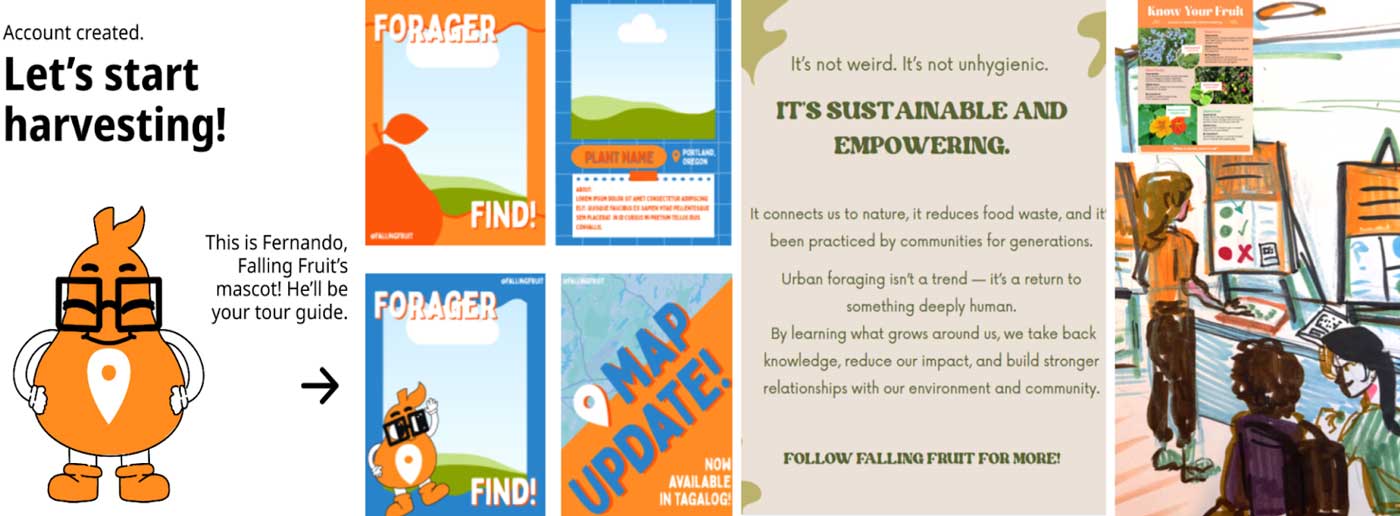
Thank you to Adrian Yudushkin, Alice Lan, Amy Stefanski, Amy Zasadzinski, Anna Huang, Anna Luebker, Annabelle Zhou, Arvind Ravi, Ashley Nguyen, Azzaya Munkhbat, Bharathi Chonachalam, Charlotte Beatty, Charlotte Friedman, Cindy Zhou, Daniel Tijesuni, Eden Jade Balceta, Edlyn Liang, Ella Crowder, Emma Krgo, Evan Chen, Felicia Renelus, Grace Lee, Hayden Becker, Isabella Brown, Izzi Cain, Izzy Chun, Jessica Moskowitz, Jessica Wu, Joy Mutimura, Justin Luu, Kaci Norman-Pace, Kathy Sun, Kelly Jahn, Kelly Tran, Kymira Parker, Layla Kapadia, Leona Lai, Lhaye Dimarucut, Lily Qin, Maithili Mishra, Manjusri Gobiraj, Maria Goretti Steve, Matt Coles, Megha Verma, Meghana Appidi, Michele (Mandula) Endean, Michelle Bedolla, Naomi Crowder, Nathan Rodriguez, Nela Schechtman, Reid Chambers, Sandhini Ghodeshwar, Sarah Roman, Shanthini Baskar, Sharon Klotz, Sneha Subramanian, Sophia Ho, Sophie Meade, Tawni Johnson, Tiffany Teng, Tiffany Vuong, Vicky Huang, Virginia Patterson, Ward Bullard, Wendy Moy, Wilson Ho, and Zihan Zhao.
User survey
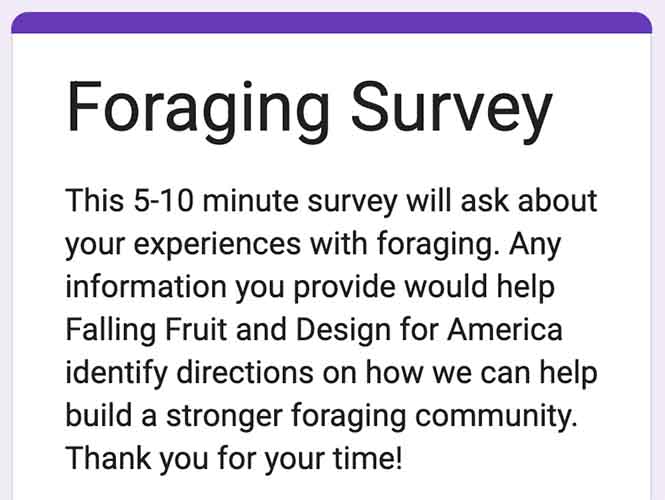
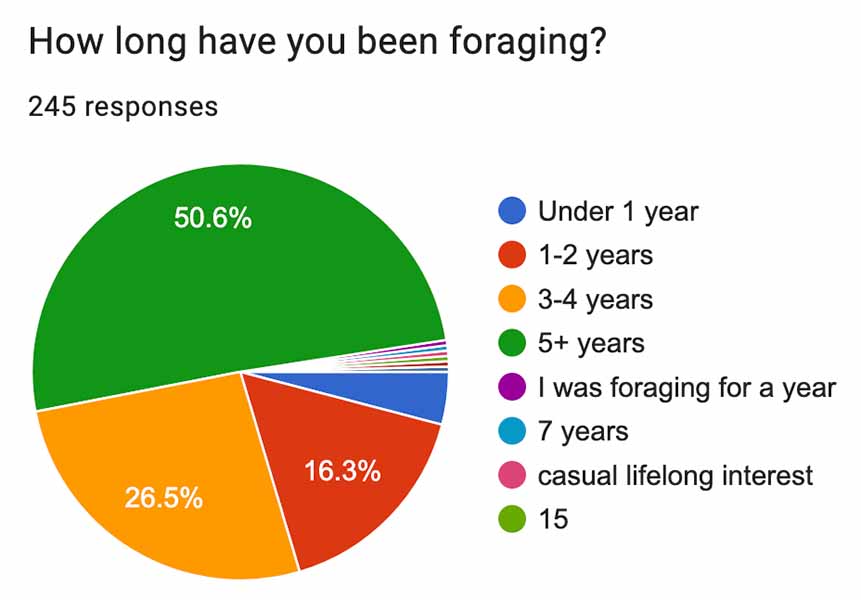
One of the DFA teams prepared a user survey. Now is your chance to share your thoughts. Over two hundred already have and you can explore their responses graphically, as data, or as response summaries.
Beta website
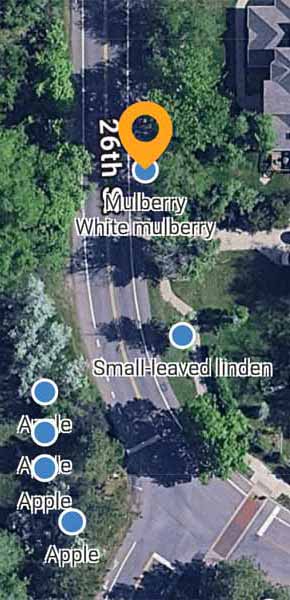
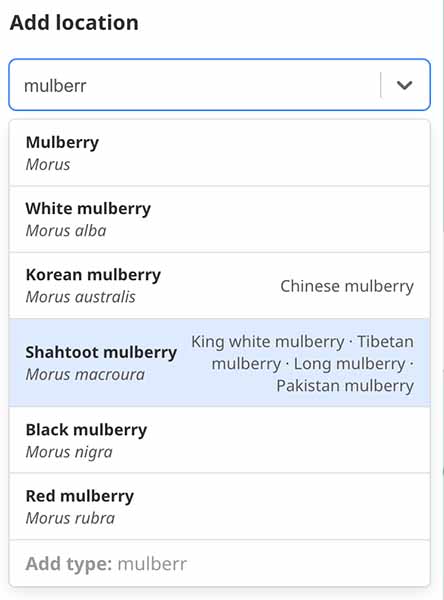
We hear you: the mobile app could be better... and a major update is coming. But rather than wait, try the mobile-friendly beta website (beta.fallingfruit.org). There you can filter by multiple types, search by synonyms, suggest new types, post multiple photos per review, report problematic content, edit or delete your reviews, and delete locations you added (if they haven't yet been reviewed or edited by others).
Want to help with code or design? Join us on GitHub!
Highlights
Initiatives
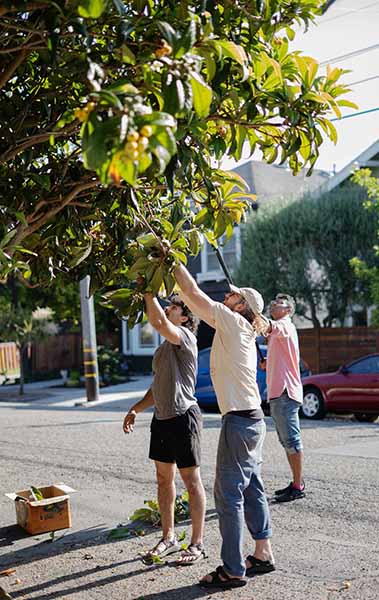
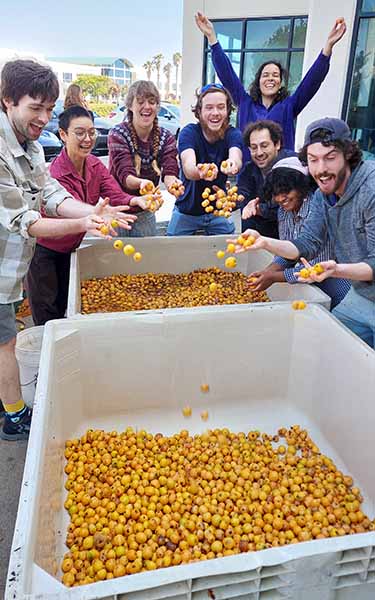
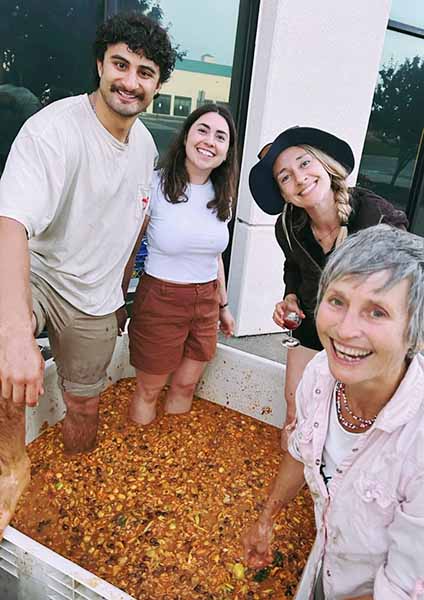
Feral Ecology is an Oakland, California-based project weaving foraging, fermentation, and community building. We host public fruit harvests (including from trees found on Falling Fruit), teach workshops on foraging and fermentation, and make our own wild wines, ciders, and meads. By connecting people to the land and one another, we aim to cultivate wholeness for a more resilient future. You can read more about our recent loquat harvest, or follow our announcements on Instagram at @feralecology. Come out for a harvest, join a workshop, or reach out about tasting our feral ferments!— submitted by Daniel Goldberg, founder
- Fruta na Rua maps public fruit trees in Belo Horizonte, Brazil to encourage city residents to enjoy and care for them (map).
Individuals
- User TJ Butler in Baltimore, Maryland, USA worked with Ethan and city staff to import the city's tree inventory (map).
- Rennes, France lies in the heart of one of Brittany’s iconic apple-growing and cider-making regions. User MPG pointed us to the large number of community orchards in the city, which led Ethan to import the city's tree inventory (map). Over one hundred different apple cultivars are listed!
In the media
- We imported the tree inventory for Colorado Springs, Colorado, USA (map) to coincide with an article in The Gazette, which includes an interview with city forester Jeff Cooper.
- In an article in Reasons to be Cheerful, Ethan’s words...
- Katherine Cusumano's contemplative essay in Oregon Humanities explores the "unexpected abundance of urban plant life."
"Almost every tree in a city was put there because of a human decision," says [Ethan] Welty. "That means we have the power to reshape those decisions: to plant fruit trees instead of purely ornamental ones, to design spaces that nourish people instead of just looking nice."... are made more tangible by Christopher Macy, founder of the Phoenix Urban Food Forest Initiative.
"Now, we're on over 11 parkways with more than 90 fruit trees and over 100 perennial vegetable plants. [...] We can grow food and have food for our neighborhood," says Macy. "It brings a little balance between urban and rural."
Perhaps my interest in foraging was also about rethinking my notions of where I could find nature. [...] it wasn't only undisrupted wild space; it was here, in the city, too.
What we're reading
- Residential housing segregation and urban tree canopy in 37 US Cities in npj Urban Sustainability
- Orchards for edible cities: Cadmium and lead content in nuts, berries, pome and stone fruits harvested within the inner city neighbourhoods in Berlin, Germany in Ecotoxicology and Environmental Safety [free version]
Redlining was a racially discriminatory housing policy established by the federal government's Home Owners' Loan Corporation (HOLC) during the 1930s. [...] Our analysis of 37 metropolitan areas here shows that areas formerly graded D, which were mostly inhabited by racial and ethnic minorities, have on average ~23% tree canopy cover today. Areas formerly graded A, characterized by U.S.-born white populations living in newer housing stock, had nearly twice as much tree canopy (~43%).
Here, we determined cadmium and lead content in the edible parts of nuts, berries, pome, and stone fruits harvested from fruit trees and shrubs within inner city neighbourhoods of Berlin, Germany. [...] Higher overall traffic burden and proximity to roads increased whereas buildings or vegetation as barriers reduced trace metal content in the edible biomass. [...] Trace metal contents of urban fruits were similar or below to supermarket samples [...] and does not pose a risk on human health, as long as the fruits are thoroughly washed.
— Ethan & the Falling Fruit team